

Optimal Angle to Hit a Baseball
Rationality in Game Theory
When an introductory physics student is asked, "At what angle should one hit a baseball to obtain maximum distance?" the most common answer is 45 degrees. This is correct under the simplifying assumptions of introductory physics. In reality, however, the optimal angle depends on numerous factors including wind conditions, bat construction, the type and spin of the incoming pitch, compression of the ball at impact, aerodynamic effects from the ball's stitching, among others.
These complexities mean the optimal angle varies from day to day and even from pitch to pitch. Yet professional baseball players consistently hit the ball very close to optimal, adjusting to the conditions, despite their lack of physics training.
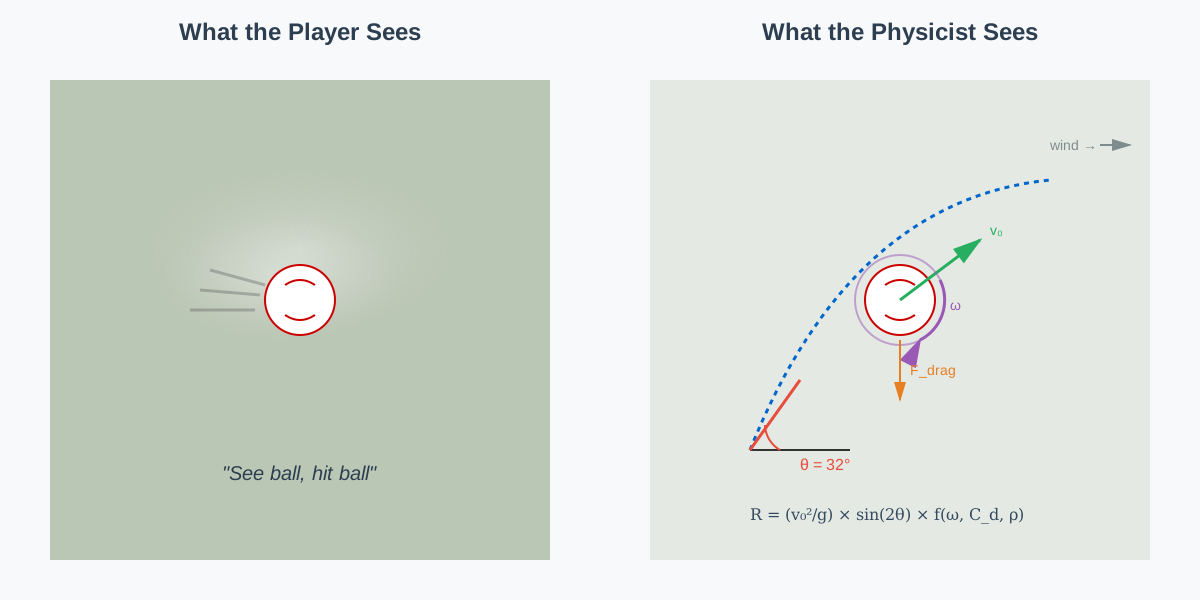
We can interpret "rationality" in two distinct ways. Procedural rationality concerns how people actually make decisions: Do they calculate expected utilities? Do they solve optimization problems? In this sense, baseball players are clearly not "rational"—they do not consciously compute launch angles using differential equations during the fraction of a second available to react to a pitch. We interpret "rationality" not as an assumption about how people make decisions, but as a tool for analyzing how people learn to act. A professional baseball player does not hit the ball optimally due to a study of physics, but due to years of practice and adaptation.
If we want to predict how a professional baseball player will hit the ball in a given situation, the answer a physicist would calculate is likely to be very close, even though the underlying decision process is intuitive rather than calculative.
This example illustrates how we think of rationality in game theory. Rational behavior does not refer to the cognitive processes people use (even though that's how it is often defined). Rationality refers to how people act, often as a result of learning rather than explicit optimization. This also suggests some limitations to game theory, as people cannot expect to act rationally in novel environments.
For those who are very curious, the following offers a good introduction to the physics of hitting a baseball:
The MLB now tracks swing angles for each player and each pitch:
And this physics article provides the calculations involved:
With other physics articles addressing related issues: